How to Choose a Mattress in a Showroom
Buying a mattress is one of the most important purchases you'll make for your home, and one of the easiest to get wrong. Most people spend more time researching a new phone than they do choosing something they'll sleep on for the next eight to ten years.
The good news is that a showroom visit, done properly, cuts through all of that uncertainty. You cannot replicate the feel of a mattress from a product description or a five-star review. But you can walk out of a showroom with genuine confidence, if you know what you're doing when you get there.
This guide covers everything: how to prepare, what to test, how to read your body's signals, and the questions worth asking before you commit.
Key takeaway: To choose a mattress in a showroom, lie down in your actual sleeping position for at least 10 minutes, test firmness by checking spinal alignment, limit yourself to four to six models, and bring your partner if you share a bed. The showroom is your best tool. Use it properly.
![]()
Before You Go: What to Know in Advance
Settle three things before you visit: the position you actually sleep in, the size you need, and a rough budget. You do not need to arrive as a mattress expert, and over-researching can work against you.
If you walk in with a fixed idea of what you want, you may dismiss options that would actually suit you better. The goal of pre-visit preparation is to arrive with clarity on a few personal factors, not a shortlist of product names.
Know your sleep position
Your sleeping position is the single most important variable in choosing a mattress. It determines where your body needs support and how much pressure relief your joints require.
- Side sleepers need a mattress that allows the shoulder and hip to sink in, keeping the spine level. A mattress that is too firm will push back against those pressure points and cause discomfort.
- Back sleepers need support through the lower back. The lumbar curve should be gently supported, not flattened or exaggerated.
- Front sleepers need a firmer surface to prevent the hips from sinking too low, which strains the lower back.
- Combination sleepers (those who move between positions) benefit from a responsive mattress that adjusts quickly as they shift.
Know your size requirements
If you already have a bed frame, your new mattress must match its dimensions exactly. UK standard sizes are single (90 x 190cm), small double (120 x 190cm), double (135 x 190cm), king (150 x 200cm) and super king (180 x 200cm).
If you are buying both a frame and a mattress, consider sizing up. Which? advises that you and your partner should both be able to lie on your back with your hands behind your head without your elbows touching each other or the edge of the bed. It is a quick test, and it is the one couples most often wish they had done.
Set a rough budget, but keep an open mind
Set a range rather than a ceiling, and let comfort guide the final decision. A mattress is not the place to compromise on quality: a good one will last eight to ten years, which puts even a £1,000 mattress at roughly 34p a night across eight years.
Arriving with a hard ceiling tends to rule out the mattress that was right for you by a margin of fifty pounds. Arriving with a range lets you weigh that difference against eight years of sleep.
![]()
How to Test a Mattress in a Showroom
Lie down in the position you actually sleep in, stay there for at least 10 minutes, and check that your spine stays level. That is the whole test, and it is the part most people skip.
They perch on the edge of a mattress, press it with their palm, and move on. That tells you almost nothing. Here is how to do it properly.
Step 1: Dress for it
Wear comfortable, lightweight clothing, and take off your coat, your shoes and anything bulky. The more closely you replicate your actual sleeping conditions, the more useful the test will be.
Showrooms expect this, and display mattresses are covered for exactly that reason. Nobody working in a bed department finds it odd.
Step 2: Lie down in your real sleeping position
Lie in the position you actually sleep in, not the one that feels least awkward in public. If you are a side sleeper, lie on your side. If you sleep in a foetal position, adopt it.
Amy Lockwood, sleep editor at Ideal Home, makes the point directly: most people stick to lying on their backs in a showroom, and unless you sleep solely on your back, one position will not give you enough data to make the right choice.
Step 3: Stay on it for at least 10 minutes
Give every mattress you are seriously considering 10 to 15 minutes. A 30-second lie-down tells you almost nothing, because nearly every mattress feels comfortable for the first few seconds.
Your body needs time to settle, relax, and register whether any pressure points are building. This step is non-negotiable, and it is the single biggest difference between a good showroom visit and a wasted one.
Step 4: Check your spinal alignment
Your spine should hold roughly the same shape lying down as it does when you are standing. This is the definitive test for whether a mattress is right for you.
- Back sleepers: Slide your hand under the small of your back. It should be mildly difficult to get your hand under. If it slides in easily, the mattress is too firm. If you cannot get it under at all, it is too soft.
- Side sleepers: Ask a companion to take a photo of your back with your phone. Your spine should form a straight horizontal line from neck to tailbone. If it bows upward or downward, the firmness is wrong.
- The hip-and-shoulder check: Lie on your side and notice whether your hips and shoulders sink in slightly. They should. If they feel pushed upward, the mattress is too firm for your body weight.
Step 5: Test the edges and motion isolation
Test the edge of the mattress as well as the centre, and test motion transfer if you share a bed. Edge support matters if you tend to sit on the side of the bed to get up, and it decides how much of the surface you can actually use.
For motion isolation, have your partner sit down heavily on their side while you lie still. If you feel significant movement, the mattress will disturb your sleep every time they turn over.
Step 6: Test no more than four to six mattresses per visit
Four to six models is about as many as anyone can hold in their head and compare usefully. Testing more than that in one session creates confusion rather than clarity.
It is easy to feel overwhelmed in a well-stocked showroom. Focus on a shortlist, take a break, and come back with a clearer head if you need to.
Practical tip: Bring your own pillow if you have a preferred one, or ask the showroom to provide a similar style. The pillow and mattress work together to maintain spinal alignment, so testing them in combination gives you a more accurate result.
Understanding Mattress Types
The four constructions you will meet in most showrooms are pocket sprung, memory foam, hybrid and latex. Each one suits a different kind of sleeper, and none of them is better than the others in the abstract.
When a showroom advisor asks what type you are looking for, you want to have a working answer. Here is a plain-English breakdown.
Mattress Type How It Feels Best For Watch Out For Pocket sprung Responsive, bouncy, breathable Hot sleepers, combination sleepers, those who prefer a traditional feel Can be heavy; some models develop noise over time Memory foam Slow-contouring, pressure-relieving, motion-absorbing Side sleepers, joint pain, light sleepers disturbed by a partner Can retain heat; harder to change position at night Hybrid Balanced: supportive spring base with foam comfort layer Couples, warm sleepers, those wanting the best of both Higher price point; quality varies significantly between brands Latex Naturally bouncy, responsive, breathable Hot sleepers, allergy-conscious buyers Not suitable if you have a latex allergy; heavier to handle A note on spring counts
For pocket sprung and hybrid mattresses, spring count matters but is not the whole story. A higher count generally means better zoned support and improved breathability, but the quality of the springs and of the comfort layers above them matters just as much as the raw number.
Treat the number as one data point rather than a ranking. Two mattresses with the same spring count can feel completely different, which is exactly why you have to lie on them.
Natural fillings
Premium mattresses often use natural comfort fillings such as wool, cotton, cashmere or silk. These regulate temperature well and tend to feel more luxurious than synthetic alternatives.
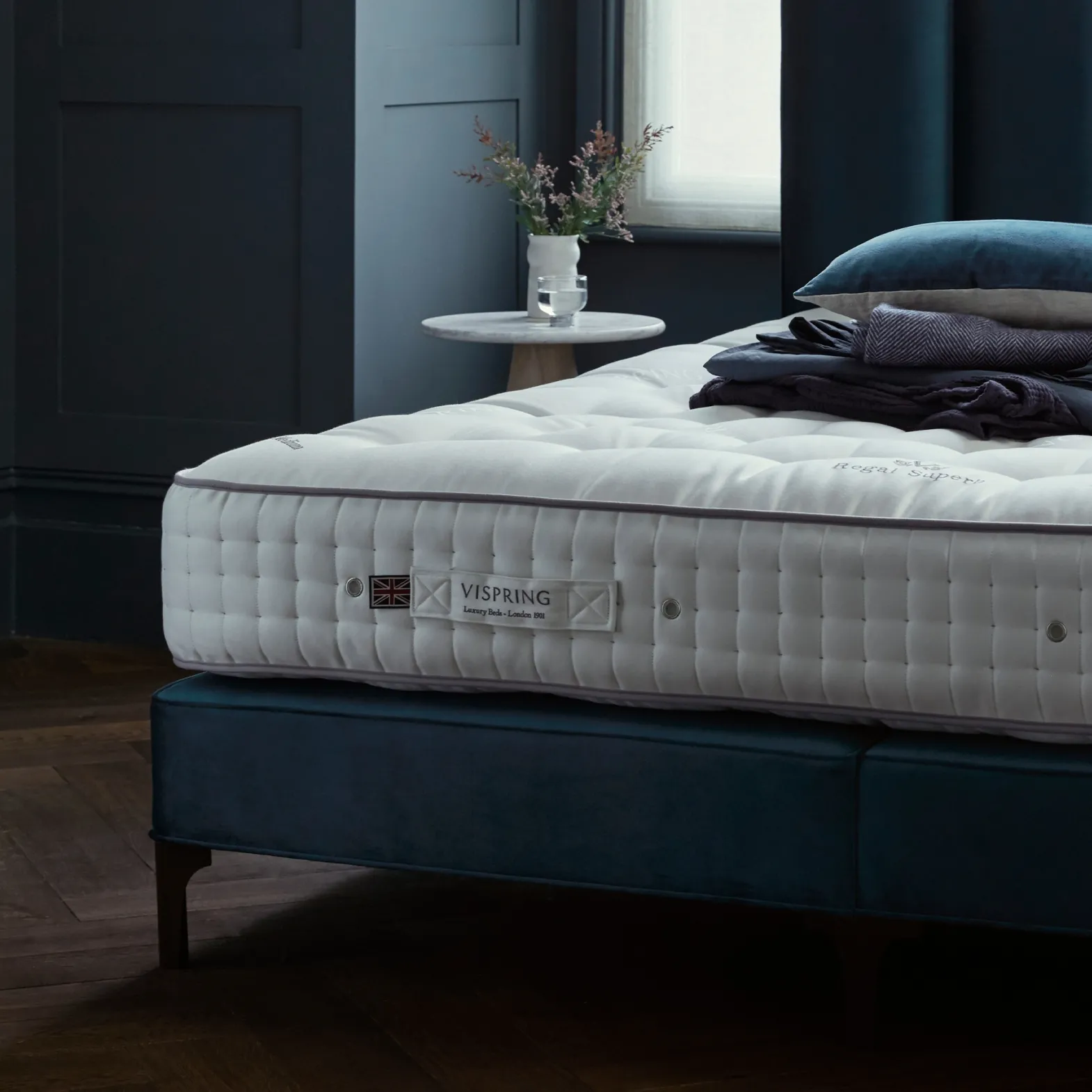
Brands including Hypnos and Vispring use natural fillings extensively across their ranges. If you run warm at night, ask specifically about the filling materials, not just the mattress type.
How to Choose the Right Firmness
The right firmness is the one that keeps your spine in neutral alignment for your body weight and sleep position. It is not a preference, and it is not the same thing as support.
Firmness is the most misunderstood part of mattress buying. The word "firm" does not mean "supportive", and "soft" does not mean "unsupportive".
The key principle: A mattress should support the natural curves of your spine without either pushing them out of alignment (too firm) or allowing them to collapse (too soft).
Firmness by body weight
Body weight changes how a mattress feels, so two people can lie on the same mattress and reach opposite conclusions. It is a significant factor that most guides underplay.
- Lighter sleepers (under 65kg): A firmer mattress will feel harder than it should and may not allow enough contouring. Medium or medium-soft tends to work better.
- Average weight sleepers (65 to 90kg): Medium to medium-firm covers most people in this range, though sleep position still plays a role.
- Heavier sleepers (over 90kg): A firmer, denser mattress is usually needed to prevent sinking too deep into the layers. A mattress that feels medium to most people may feel soft to a heavier sleeper.
The spinal alignment check (in the showroom)
Sliding your hand under your lower back while lying down is the most reliable real-time firmness check you have. Use it on every mattress you try seriously, and use it in the position you sleep in.
Important: Do not choose firmness based on what you think you should like. A common mistake is buying firm because it sounds healthier. The right mattress is the one your spine confirms is correct, not the one that sounds most sensible.
![]()
Questions to Ask the Showroom Advisor
Ask about the spring count and fillings, the length of the guarantee and what it covers, whether there is a sleep trial, and which base the mattress needs. Those four answers tell you most of what a product page cannot.
A good showroom advisor is one of the most underused resources in the buying process. They see hundreds of customers a year and can often narrow down the right mattress faster than you can on your own.
- "What mattress would you recommend for a side sleeper who runs warm at night?" This gives them your two most important variables and lets them filter the range for you.
- "What is the spring count and what are the comfort fillings?" The answer tells you a lot about build quality and whether the price is justified.
- "How long is the guarantee, and what does it cover?" Check whether it covers sagging and body impressions or only manufacturing defects, because those are very different promises.
- "Is this available with a sleep trial?" Some retailers offer a home trial period. This is worth asking about because even an excellent showroom test cannot replicate eight hours of real sleep.
- "What base does this mattress need?" The bed base affects how a mattress performs. A slatted base, a divan, or a platform top all interact differently with the mattress above them. Confirming compatibility before you buy prevents a costly mismatch.
- "Can I come back and try it again before I decide?" Any reputable showroom will say yes. There is no pressure to decide on the day.
A note on the base: If you are buying a new base alongside a mattress, test the mattress on the same type of base it will sit on at home. At Roomes, our advisors check your base situation before making a recommendation, because the combination matters as much as the mattress alone.
Common Mistakes to Avoid
The five mistakes that catch most buyers are rushing, choosing on price alone, defaulting to a partner's preference, replacing like for like, and ignoring the bed base. Each one is easy to avoid once you know it is there.
Choosing based on what your partner prefers. If you and your partner have different firmness needs, do not default to one person's preference. Look at zip-and-link mattresses, which allow different firmness levels on each side of a king or super king bed.
Buying the same type as your last mattress. If you slept badly on your old mattress, that is not an argument for buying the same type again. Use the showroom to explore different constructions, not to replicate what you already have.
Ignoring the bed base. A new mattress on a worn-out or incompatible base will not perform as it should. If your base is more than eight years old, it is worth reviewing it alongside the mattress.
Making the decision on price alone. A mattress at the lower end of its range is not automatically a bargain. Within any type, the quality of materials and construction varies enormously. The showroom test is your best protection against buying something that underperforms.
Rushing. The single most common mistake. Give yourself enough time in the showroom to test properly, ask questions, and sit with your decision. A quality retailer will never pressure you to buy on the spot.
Ready to Try Mattresses in Person?
The best mattress for you is the one your body tells you is right, and you can only find that out by lying on it. No online guide, review site or product description can replace 10 minutes on your side with your eyes shut.
At Roomes in Upminster, we have over 70 beds and mattresses in store to try, from brands including Hypnos, Vispring and Tempur. Our advisors are there to help you test properly, not to push a quick sale. Take your time, bring your partner, and leave with a decision you are genuinely confident in.
Browse our bed and mattress range or visit us in store at our Upminster showroom.
- 8th August 2026